A Winter, Alpine Climb
Taking a break from cross-country skiing, Markus and I took a rewarding New Year's Day hike.

Greetings from Obergoms, a municipality located in the upper-most valley of the Rhone River in the Swiss canton of Valais. The valley, especially the wide plateau where I’m situatedas I write, is a winter destination treasured by cross-country skiers. The groomed trails for classical and skating disciplines feel endless. They include long open stretches and challenging climbs into forested slopes. In January, the region hosts a World Class ski competition, attracting sport giants like Jessie Diggins and Johannes Høsflot Klæbo.
Snow does not fall heavily very often here. So far this season, 2025–2026, a minimal amount of snow covers the valley floor and precludes daily trail grooming. Some of the more challenging trails lack enough snow to open, but the surfaces of the open trails are drivable. Conditions of the tracks around the Nordic Ski Center are faultless.
Up to mid-elevations, the abundant sunshine has freed the south-facing slopes of snow. Packed snow lingers in patches on forested stretches of access roads.
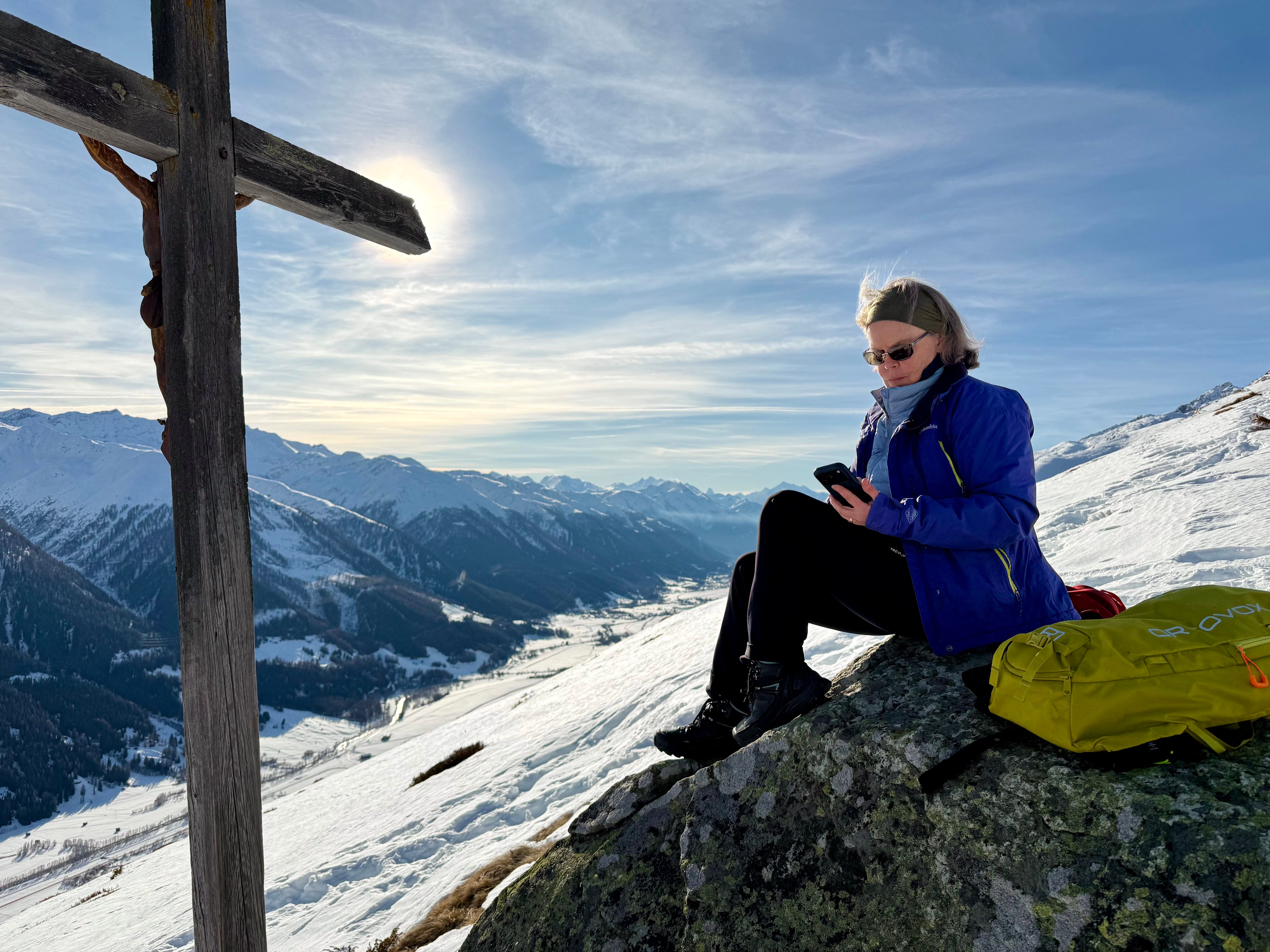
Markus and I, after enjoying five sun-filled days of cross-country skating, decided to hike up the snow-free slope to a cross close to the Üerlichergale, at an elevation of 2100 meters (6890 feet). The climb would take us up 700 meters (2300 feet). We packed water and the typical Swiss hikers’ picnic, sliced smoked ham, cheese, bread, and firm fruits—an apple for Markus and a persimmon for me.


We both went to bed well before midnight on the last day of 2025. Fireworks woke us at the moment 2026 began. For a bit, snug in my bed, I listened to the pops and crackles coming through the open window before falling back to sleep. I got up at my usual five o’clock, the bedroom icy cold but the rest of the condo warm. The temperature had dipped to -14 Celsius (6.8 Fahrenheit) that night. It would stay below freezing the entire day. By 10 o’clock, when Markus wanted to head out, it was still -12 degrees. I insisted we wait until 10:30, which is when we started packing. We got out the door closer to 11:00 o’clock and -10 degrees.
By the time we’d climbed 200 meters up the sunny slope, we were shedding our coats. I still wore a thin down vest, but Markus wore only a cotton shirt over long underwear. At a turn nearing the halfway mark, Markus pointed at mountains far down the valley where a familiar peak stood out. “The Matterhorn,” he said. “The first view we get of it.” The start of the valley up to Zermatt and the Matterhorn is visible from our place in Ulrichen; it’s marked by the Weisshorn peak, which I admire each morning from the kitchen table where I write, the sunrise painting its snowcapped peak rose.


We took a short halfway break, ate our fruit, and greeted a young man sunning himself on a bench. We now confronted packed snow covering the track. Unavoidable for the rest of the climb and demanding our focus.
I was reminded of a hike we took in a similar dry winter-week we spent in Santa Maria in Val Müstair. From the village apartment we rented from a friend, we took off for the hamlet of Lü, a climb of 600 meters (1970 feet). It was later in the season, March, and temperatures were rising. The snow on the trails, which had been groomed earlier in the season, were softening considerably, the going slow as we picked our way, aiming each footstep for the firmest surface. Each miscalculation resulted in a jolting plunge up to our knees in wet snow. A story I wrote inspired by the conditions, “Blackbird Flies” appeared in the digital magazine CafeLitMagazine.
We unpacked our picnic and took photos at a boulder and cross overlooking the Goms Valley. The air still below zero degrees yet comfortably warmed by the sun. A swarm of blackbirds rode thermals above us. Our phones pinged with well wishes for the year. A bit hazy in the distance, the Matterhorn.


The iron Jesus mounted on the cross is warm to the touch. To the west of him, farther down the valley, Crans Montana is in shock, following a deadly fire and explosion in a bar popular with young people, locals and tourists alike. To the east of him, within hiking distance in friendlier seasons, the Rhone Glacier, shrinking rapidly due to our impact on the Earth’s climate.
I think of a question that popped up in an article I read recently, “Is man inherently bad?”
What a question to think of while in the icy fresh air and facing a wondrous landscape as well as all the prospects a new beginning seems to offer. Somehow significant in the place and moment. If good and bad (or evil) exist in our vision of the world, no matter their measures, then how could they not exist in each of us? In various cultures and religions, bad acts are introduced, not inherent. In Western culture, think Pandora’s box or Original Sin. But even if we’re not born bad, we certainly can’t escape a life filled with bad acts. “This year,” I say to myself, “I wish to focus on good acts, kinder acts as well as being more appreciative and grateful for the goodness that surrounds me. Family, nature, and health.”
Down we trekked from our elevated picnic, the sun lowering in the sky, and our coats back on. “How about a cheese fondue for dinner tonight?” Markus said. Sounded just about right to me. Markus prepared the fondue as he always does, and we sat down to enjoy the bubbly meal and watch replays of the day’s 20–kilometer pursuit cross-country ski races on TV. Two heroes won: Jessie Diggins and Johannes Høsflot Klæbo.
Cheers to your 2026. May it be filled with goodness, family, nature, health—an occasional commune with nature and tasty meals.


I can see the trails now and taste/smell the fondue! Happy New Year to you both.